Business Banking is a comprehensive digital platform designed for companies that need to operate, control, and optimize their finances in a centralized, secure, and efficient manner. This solution allows companies to manage everything from their daily cash flow to accounts payable and receivable administration, with flows adapted to corporate operations and tools geared toward financial and human resources teams.
The system covers everything from the onboarding process and initial tax configuration to specialized modules for bank account management, transaction reconciliation, bulk payment distribution, income control, payroll payment automation, and invoice management.
Its web interface is designed to facilitate collaborative work between different users with different roles within the organization.
This platform is not intended to be a simple business account, but rather an adaptable banking technology solution designed to address the operational complexities of a modern company.
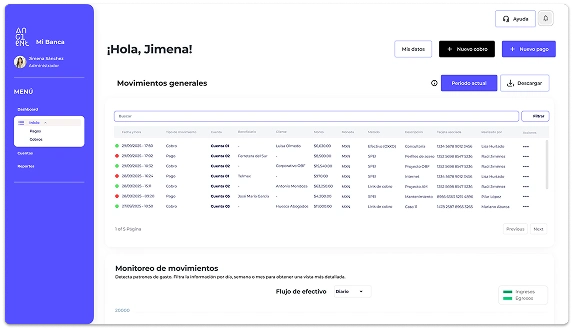
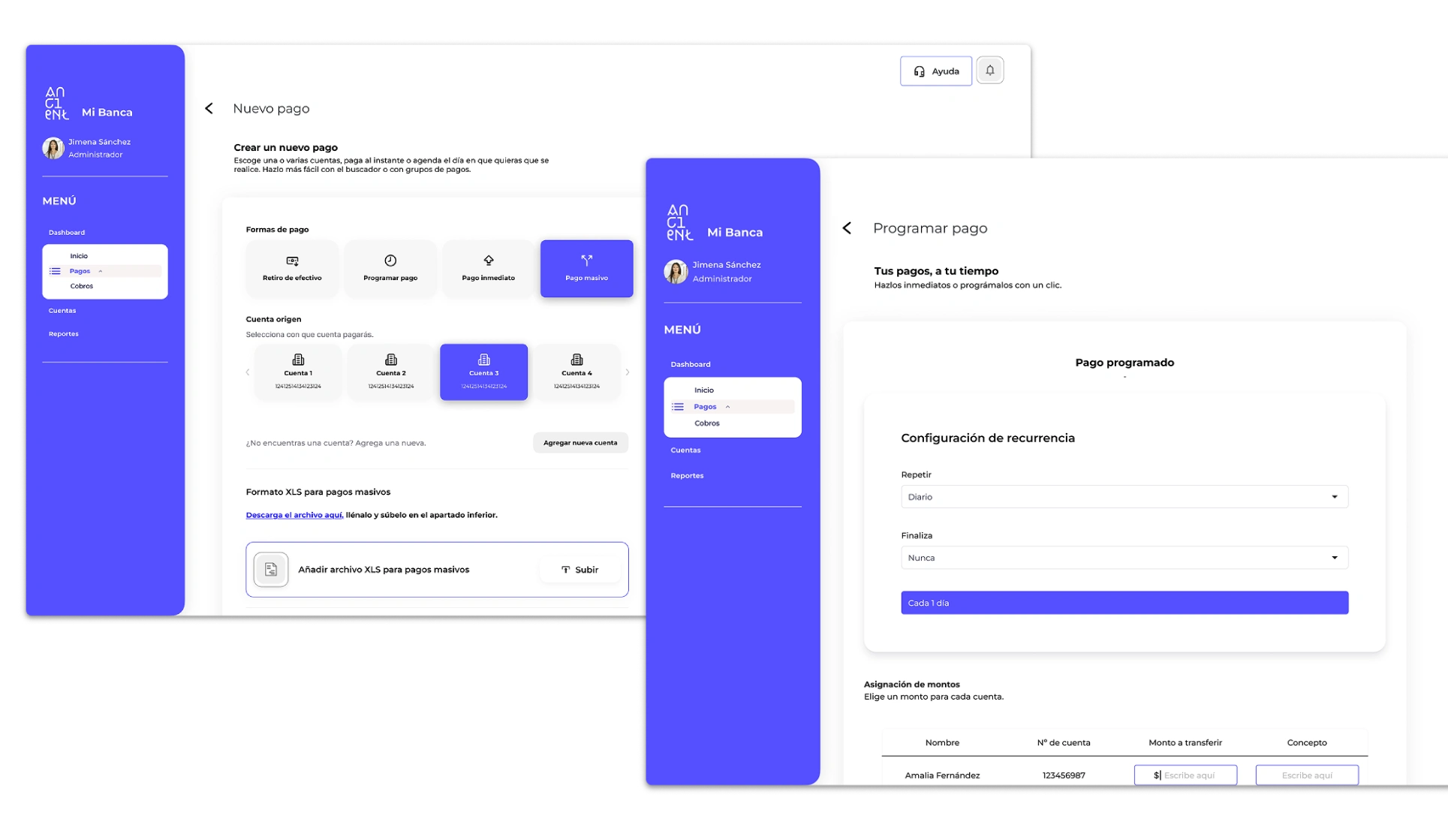
The Business Banking platform is designed for financial institutions, fintechs, and companies that require a scalable and secure solution to operate their day-to-day financial activities. Some of the main use cases include:

Companies with high transaction activity that require control and traceability over multiple inflows and outflows of funds.
B2B fintechs that offer treasury, account, or payroll products as part of their portfolio.
Payroll solution providers who need to distribute payments to employees, contractors, or third parties in an automated manner.
Corporations that operate with multiple accounts payable and receivable, and require a tool that integrates cash flow, reconciliation, and reporting.
Companies seeking to digitize manual payment, control, and financial monitoring processes within their central operations or branches.
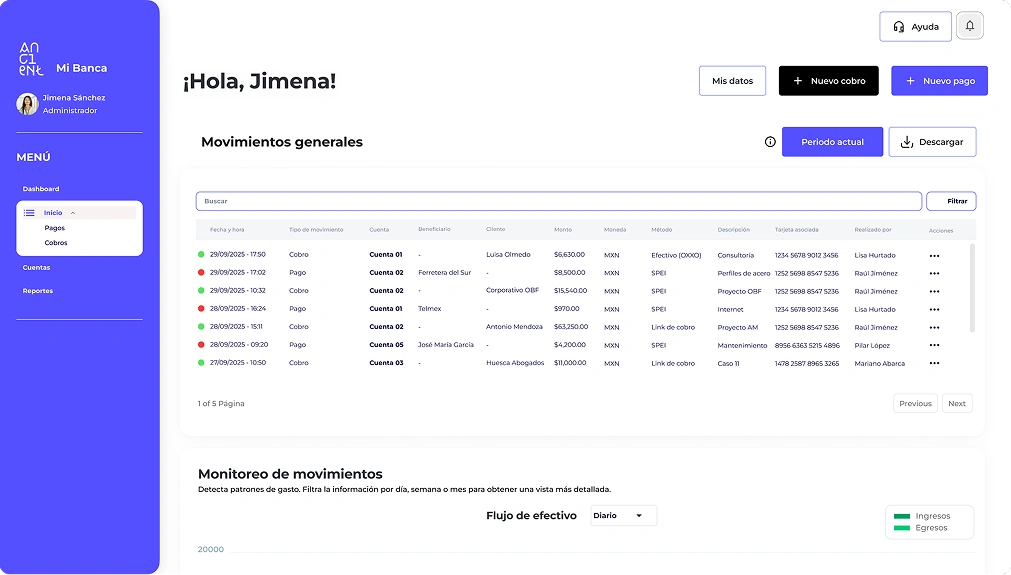
The product comprises a series of features that enable comprehensive coverage of a company's financial operations. Key components include:
Individualized CLABE/SPEI account, with the ability to receive and send interbank transfers.
Balance and transaction control panel, with real-time display, advanced filters, and automatic transaction categorization.
Payment module, which allows for the payment of services (public and private), fund distribution, scheduled or bulk payments.
Collection functionality, with generation of references for SPEI deposits, cash, or collection links with automatic confirmation.
Cash payments and collections through an integrated network of banking correspondents.
Digital identity validation, adaptable to individuals (KYC) and legal entities (KYB), with differentiated flows depending on the type of user and regulatory requirements.
White-label infrastructure, which allows you to customize the brand, colors, flows, domains, and contact channels of the institution operating the corporate banking.
The Business Banking solution is organized into functional modules that structure and organize the product's capabilities. Each module is designed to meet a specific operational need of the customer: from account creation and user management to complex cash flow, payments, and accounting management.
This modular architecture allows for flexible implementation, where each organization can activate only the components it needs, according to its operations, business model, and internal capabilities. All modules are integrated under a single platform, ensuring a consistent, secure, and efficient experience for both the administrator user and the finance, technology, and compliance teams.
The following describes the available modules and the main features contained in each one.
The access flow is designed for companies that require security from the first contact. It allows the creation of a business account with institutional email, telephone number validation and confirmation via OTP code. From the first access, the system detects the type of person (physical with business or moral activity) and automatically activates the corresponding flows. Subsequent login includes email and password authentication, session reminder, password recovery with validation and control mechanisms for multiple failed attempts.
This module seeks to ensure a frictionless access experience, but with the necessary controls for corporate environments where security, traceability and data protection are essential. It can be configured later with biometric or multi-factor authentication if the operation requires it.
Once the account is created, the system requests the formal configuration of the company's data. This includes corporate name, RFC, tax regime, tax address and other key data for tax compliance and CFDI generation. The module is prepared to support both transactions with a single corporate name and schemes where there are multiple related tax entities.
In addition, it allows you to establish electronic billing preferences, such as the use of CFDI by default, receipt of the receipt and accounting categorization of income and expenses. This section also centralizes cross-validation with SAT and blacklists, to avoid inconsistencies when issuing or receiving invoices.
Depending on the type of person, the platform deploys a digital verification flow aligned with current regulations:
This module ensures compliance with regulatory obligations (such as PLD/FT) and can be adjusted according to the type of company, amount to be operated or level of risk assigned.
This module allows companies to directly manage the users who will have access to the Business Banking platform. From a centralized panel, the administrator can register new collaborators, edit existing information or eliminate obsolete access without the need for operational intervention by the bank or technical support.
The registration of each collaborator is carried out through an automated flow that includes the sending of an invitation via email, initial registration with secure credentials and confirmation of identity. The system is designed to ensure that each employee only has access to the authorized environment from verified devices, thus reinforcing organizational security.
This module is key for medium and large companies that need to delegate financial tasks without compromising control. All actions are recorded with full traceability and can be audited from the customer management backend.
Unlike other products on the market with rigid role schemes, Business Banking allows you to configure completely customizable profiles, adapted to the internal structure and specific needs of each customer.
The administrator can define which modules will be available to each collaborator and what actions he can perform within them: reading, uploading information, authorizing, downloading reports, and others. These permissions can be changed at any time and apply immediately. It is also possible to configure staggered approval flows, where certain operations require multiple signatures or internal validations before being executed.
This level of granularity provides absolute control over access to critical functions such as transfers, mass payments, reconciliation or account management. In addition, operational and compliance risks are minimized by ensuring that each user has access only to what is necessary for their role, aligned with good corporate governance and financial control practices.
The digital signature module enables the secure and legally binding validation of critical operations within the platform, such as the approval of payments, contracts or the validation of identity in sensitive flows. The solution is integrated with Incode, making it possible to take advantage of a highly reliable biometric and documentary verification process, without friction for the user.
When an action requires a digital signature, the system generates an automatic request that is notified to the responsible user. This will be able to authenticate your identity through facial biometry, a single-use token (OTP), or through pre-configured documentary verification.
The solution complies with applicable standards for advanced electronic signatures and is ready to operate in compliance with regulatory frameworks such as NOM-151 and local financial regulations.
All signatures are time-stamped and cryptographic evidence, allowing full traceability in the face of audits or disputes. This provides an additional level of security, reduces exposure to internal fraud, and eliminates dependence on external signature solutions to maintain the integrity of corporate processes.
The digital signature module enables the secure and legally binding validation of critical operations within the platform, such as the approval of payments, contracts or the validation of identity in sensitive flows. The solution is integrated with Incode, making it possible to take advantage of a highly reliable biometric and documentary verification process, without friction for the user.
When an action requires a digital signature, the system generates an automatic request that is notified to the responsible user. This will be able to authenticate your identity through facial biometry, a single-use token (OTP), or through pre-configured documentary verification. The solution complies with applicable standards for advanced electronic signatures and is ready to operate in compliance with regulatory frameworks such as NOM-151 and local financial regulations.
All signatures are time-stamped and cryptographic evidence, allowing full traceability in the face of audits or disputes. This provides an additional level of security, reduces exposure to internal fraud, and eliminates dependence on external signature solutions to maintain the integrity of corporate processes.
Companies can view all their operating accounts from a single panel. Each account shows available balance, retained balance, and full transaction details. It is possible to have multiple accounts for different social reasons, cost centers, or operational purposes (e.g. payroll, vendor payments, mirror accounts, etc.).
From here you can: check movements in real time, apply filters by date, category or amount, export reports, download receipts and generate deposit references. This functionality is key to the company's daily operation and adapts to both simple models and multi-account operations.
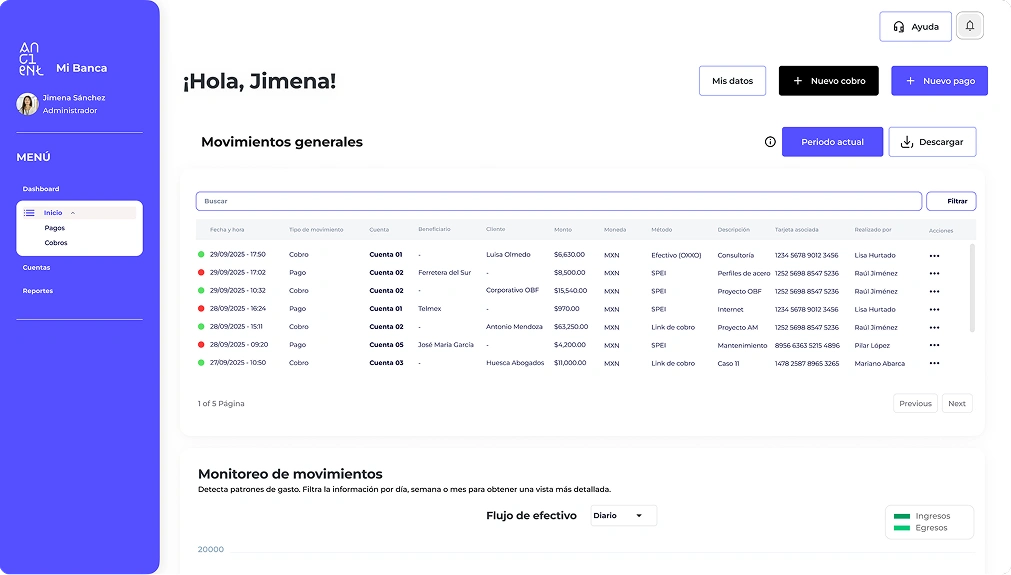
This module provides a centralized view of all of the company's financial activity. Consolidate revenues, expenses, payments, collections, movements between accounts and other cash flows. The interface allows you to navigate through advanced filters (by type, category, customer or supplier) and generate reports with export to Excel or PDF.
Each operation can be traced from origin to accreditation, with full traceability of the user who generated it, who approved it and what its result was. In addition, automatic labels, accounting rules, and categories can be configured to simplify manual reconciliation and power the CxP and CxC modules.
Business Banking is designed to adapt to corporate environments that require high operational efficiency. In this context, the Customer Creation module allows you to streamline operations by registering in advance and managing entities with whom you have commercial or contractual relationships. This pre-registration not only simplifies the collection process, but it also ensures that all transactions are executed under validated and predefined parameters.
From this module, users can register new customers by defining key attributes such as: company name, business name, CLABE, RFC, assigned contact, payment condition, and other relevant metadata. The information captured is integrated into the company's financial ecosystem, allowing its immediate use in collection, reconciliation and financial reporting flows.
Each customer has a dashboard-like detail view, which summarizes their financial relationship with the company: age of registration, contact details, amount charged, frequency of operations and monthly behavior charts. This information allows for granular and up-to-date control over recurring revenues and the financial health of the client portfolio.
This module allows you to register and manage all payment recipients from the platform. It is designed to provide agility and precision in the daily operation of accounts payable, allowing suppliers, employees, partners or any other entity that receives resources from the company to be defined in advance.
During the registration of a beneficiary, data such as name or company name, RFC, CLABE, type of beneficiary (supplier, collaborator, etc.), contact details and payment preferences are captured. This information is available for immediate use from the payment module, avoiding reprocessing or common typing errors.
Each beneficiary has their own detailed dashboard that allows them to view the financial summary of their relationship with the company: last payments made, accumulated amounts, frequency of operations, and monthly flow charts. This view makes it easier to control expenses, plan future payments and reconcile accounting more efficiently.
The platform allows you to generate charges in different ways: through SPEI transfer, cash deposit (correspondent) or personalized payment links. The user can issue a single or recurring charge, define the due date, the concept, and assign specific references per customer.
Each bill issued is reflected in a panel with real-time status: pending, overdue, accredited. From here you can also forward notifications to the customer, download receipts and associate the collection with an accounting flow or invoice. This module is especially useful for companies with a B2B or recurring payment model.
From this section, companies can execute single, scheduled or mass payments. Each operation involves the validation of funds, selection of the source account, verification of the beneficiary and shipment with follow-up.
The module is ready for flows with multiple approvers, where one person initiates the payment, another reviews it and a third party authorizes it. It also allows you to load predefined layouts (e.g. Excel) with tens or hundreds of payments, simplifying the bulk operation.
In case of errors, the system alerts the operator and marks the payment as declined or pending correction. You can also schedule future payments and set authorization rules by amount, vendor, or category.
This specialized module makes it easy to upload and execute payroll payments securely and efficiently. The company can upload files from its ERP or use native templates, automatically validate employee accounts and RFCs and schedule the dispersion by date or cycle.
Each execution can be divided by cost center, area, or location. The system displays alerts for failed payments, allows you to edit amounts prior to execution and generates detailed reports for each run. It is designed to withstand multiple payroll cycles and extraordinary payments such as bonds or installments.
It allows you to record, consult and follow up on all invoices issued to customers. Each invoice can be linked to a collection, a customer and a specific banking transaction. The status (pending, paid, overdue), days of delay, amount and history of communications with the customer are displayed.
This module also allows you to generate automatic reminders, export reports, mark partial subscriptions and generate account statements per customer. It's key for companies with recurring sales or with a structured collection cycle.
Functionality that allows you to record the invoices received from suppliers, organize them by due date and schedule their payment from the expenditure module. Each invoice can include PDF/XML files, internal notes, user comments, and approval flows.
The module allows you to avoid duplicate payments, monitor the outflow and maintain a good relationship with suppliers by ensuring timely payments. It can also be integrated with the customer's accounting system to feed their ERP in real time.
All critical system activity generates customizable automatic alerts. This includes new registrations, declined payments, pending approvals, CxP or CxC due dates, failed validations, unusual movements, and more.
Notifications can be displayed in the app, sent by email, or triggered as push events. Each user can configure what type of events they want to receive and through which channel, allowing the system to be adapted to the operation of each company.
Custom white-label implementation
We tailor the design, branding, navigation flows, texts, and language of the application to each client's needs, ensuring an experience consistent with their identity and business objectives.
Productive infrastructure from day one
We provide scalable and secure cloud environments that are already configured for production, significantly reducing deployment times and costs.
Mature and validated technology
Robust and flexible platform, already operating in production with real customers in Mexico, ensuring technical stability and proven end-to-end processes.
Full ownership of the source code
The customer has access to a comprehensive and well-documented repository, without technical dependencies or commercial blockages. There is no revenue share or hidden transaction fees.
Modular and integrable architecture
Each component of the product can be implemented independently, facilitating progressive integrations with existing systems and adaptations to different business models.
Accelerated time-to-market
The solution is designed to launch in weeks, not months. The onboarding, customization, and integration processes are optimized to minimize risks and delivery times.
The Business Banking platform comes with a solid and reliable infrastructure of native integrations, designed to operate in productive environments with high transaction volumes. These integrations have been previously evaluated, field-tested, and are fully integrated into the base operational flow.
If alternative suppliers to those presented here are required, a technical analysis will be necessary to validate feasibility and estimate the additional integration effort required. These types of requests usually involve modifications to certified flows, so they should be treated as exceptions and managed as part of an advanced customization phase.





Integrations are interchangeable thanks to a decoupled architecture, but require additional development effort if they are not within the base stack.